How Thick Should Gym Flooring Be?
Quick answer
Choose the thickness for how you train and the heaviest weight you might drop: 10mm for cardio and light weights, 15mm for general home gyms, 20mm for free-weight areas, 30mm for heavy strength training and 40mm for Olympic lifting. Guide drop figures run from 80kg to 260kg.

Choose gym flooring thickness for how you train and the heaviest weight you might drop. On our 1 m × 1 m rubber tiles, that means 10mm for cardio equipment, benches and light free weights, 15mm for general home gyms and moderate dumbbell training, 20mm for free-weight areas and heavier dumbbells, 30mm for heavy strength training and 40mm for Olympic lifting. The published drop guide runs from 80kg for 10mm to 260kg for 40mm.
Which thickness to buy is the question customers ask us most before they order. We sell all five thicknesses, so this guide sets out our published figures, how to read them, and worked examples for common home, garage and studio set-ups.
Which thickness of gym flooring do I need?
Find the row whose use matches your heaviest regular training, then check that its drop guide covers the heaviest single weight you might drop. If two rows fit, choose the thicker one when you'll drop weights often or from height. The published guidance says the right thickness depends on your subfloor, the drop height and how often weights are dropped.
| Thickness | What it's for | Drop guide | Weight per tile |
|---|---|---|---|
| 10mm (0.4 in) | Cardio equipment, benches and light free weights | Up to 80kg | About 9.5kg |
| 15mm (0.6 in) | General home gyms and moderate dumbbell training | Up to 110kg | About 13.5kg |
| 20mm (0.8 in) | Free-weight areas, heavier dumbbells and general commercial use | Up to 140kg | About 17.5kg |
| 30mm (1.2 in) | Heavy strength training, power racks and higher-impact lifting | Up to 200kg | About 26kg |
| 40mm (1.6 in) | Olympic lifting and repeated heavy use | Up to 260kg | About 34kg |
These are guide figures and recommendations, not a guarantee of protection. The right thickness also depends on your subfloor, the drop height and how often weights are dropped.
Every thickness is the same recycled rubber tile, a nominal 1 m × 1 m covering 1 m², in plain black or black with white fleck. Browse all the rubber gym flooring tiles or pick a thickness below.
Looking for 1-inch-thick gym mats? We don't make a 25mm tile. One inch is 25.4mm, between our 20mm (0.8 in) and 30mm (1.2 in) tiles, so compare those two rows: 20mm is published for free-weight areas, with a 140kg drop guide, and 30mm for heavy strength training, with 200kg.

Products in this guide
-

10mm Rubber Gym Flooring Mats (1m x 1m)
£17.99
£14.99 ex. VATSale price£17.99
Regular price
£14.99 ex. VAT£32.00
£26.67 ex. VATUnit price -

15mm Rubber Gym Flooring Mats (1m x 1m)
£20.99
£17.49 ex. VATSale price£20.99
Regular price
£17.49 ex. VAT£33.00
£27.50 ex. VATUnit price -
20mm Rubber Gym Flooring Mats (1m x 1m)
£23.99
£19.99 ex. VATSale price£23.99
Regular price
£19.99 ex. VAT£34.50
£28.75 ex. VATUnit price -

30mm Rubber Gym Flooring Mats (1m x 1m)
£33.99
£28.33 ex. VATSale price£33.99
Regular price
£28.33 ex. VAT£48.00
£40.00 ex. VATUnit price -

40mm Rubber Gym Flooring Mats (1m x 1m)
£44.99
£37.49 ex. VATSale price£44.99
Regular price
£37.49 ex. VAT£65.00
£54.17 ex. VATUnit price -

Sample - Rubber Gym Flooring
£0.00
£0.00 ex. VATSale price£0.00
Regular price
£0.00 ex. VAT
£0.00 ex. VATUnit price


What does the drop guide figure mean?
It's the published guide to the heaviest weight each thickness is meant to take when dropped: up to 80kg for 10mm, 110kg for 15mm, 140kg for 20mm, 200kg for 30mm and 260kg for 40mm. Use it to compare thicknesses, not as a promise: the right thickness also depends on the subfloor, the drop height and how often you drop weights.
To use it:
- Work out the heaviest single weight you might drop. For a barbell, that's the bar plus its plates: a 20kg bar loaded with 120kg of plates is 140kg, the top of the 20mm guide. For dumbbells and kettlebells, it's the heaviest one.
- Pick a thickness whose drop guide covers that weight and whose "what it's for" description matches your training. Both have to fit.
- Go up a thickness if you'll drop weights often or from higher up, or if your heaviest weight is at or close to the figure.
If your gym is upstairs or on a timber floor rather than a concrete slab, read what you can lay rubber gym flooring on before you choose.
Is 10mm gym flooring enough for dumbbells?
If your dumbbells are light, yes: 10mm is published for cardio equipment, benches and light free weights, with an 80kg drop guide. The guide doesn't put a weight on "light". For a set of dumbbells, the matching rows are 15mm (moderate dumbbell training) and 20mm (heavier dumbbells). If you're unsure, start from 15mm.
For example, a 40kg dumbbell is well within the 80kg figure, but a set running up to 40kg is more than light free weights, and the 20mm row (heavier dumbbells) is the closer match. Both the use and the drop figure have to fit.
Two practical differences matter on 10mm:
- There's no 10mm edge ramp. Edge ramps are made for 15mm, 20mm, 30mm and 40mm tiles. On a 10mm floor, secure an open edge with adhesive instead.
- The size tolerance is wider. 10mm tiles are made to ±1.5% (about 985–1015mm), against 0.4–1% (about 990–1010mm) for 15mm and thicker. Dry laying the floor and swapping tiles to tighten the joints matters more.
What thickness for deadlifts, barbells and Olympic lifting?
For deadlifts and heavy barbell training, 30mm is the match: its published use is heavy strength training, power racks and higher-impact lifting, with a 200kg drop guide. Olympic lifting and repeated heavy use are published for 40mm (260kg). If your loaded bar stays well under 140kg and you rarely drop it, 20mm's free-weight use and figure may cover it.
Count the whole loaded bar. A 180kg deadlift is a 180kg bar: over the 20mm figure and within the 30mm one. If you drop the bar on most reps, or your heaviest lifts are close to 200kg, 40mm is the thickness published for repeated heavy use.
If the barbell area is part of a bigger room, see using different thicknesses in one room.
What thickness for treadmills, exercise bikes and rowers?
Our published guide lists 10mm for cardio equipment, alongside benches and light free weights. It's also the lightest tile to carry, at about 9.5kg. If the machines share the room with free weights, choose the thickness for the weights instead: one thickness throughout is simpler to lay and leaves no step between areas.
Worked examples: which thickness for my set-up?
These four set-ups are the kinds customers describe when they ask us which thickness to buy. Each answer uses only the published uses and drop guide figures above, on whole-metre floors to keep the sums simple. Tile counts cover the floor area only, before an allowance for cuts. They're worked examples, not tests of a real floor.
| Set-up | Heaviest weight dropped | Thickness | Tiles and weight |
|---|---|---|---|
| Spare room: bench and dumbbells up to 25kg | One 25kg dumbbell | 15mm | 3 m × 3 m: 9 tiles, about 122kg |
| Single garage: barbell and deadlifts up to 180kg | The 180kg loaded bar | 30mm | 3 m × 5 m: 15 tiles, about 390kg |
| Cardio corner: exercise bike and rower | None | 10mm | 2 m × 3 m: 6 tiles, about 57kg |
| PT studio: dumbbells, barbells, all-day use | Depends on the zone | 20mm, with 30mm or 40mm where bars are dropped | 6 m × 8 m: 48 tiles, about 840kg at 20mm |
Spare room: bench and dumbbells up to 25kg
15mm fits. A 25kg dumbbell is within every drop figure, even 10mm's 80kg, so the use decides: a dumbbell set is dumbbell training, which the guide puts at 15mm, while 10mm is for light free weights. Choose 20mm instead if you plan to move to heavier dumbbells or will drop them at the end of most sets. Nine tiles weigh about 122kg, over 100kg, so they come on a pallet to the kerb, and an order under £300 pays a delivery charge based on its weight. The 5% bulk discount starts at 10 tiles.
Single garage: barbell and deadlifts up to 180kg
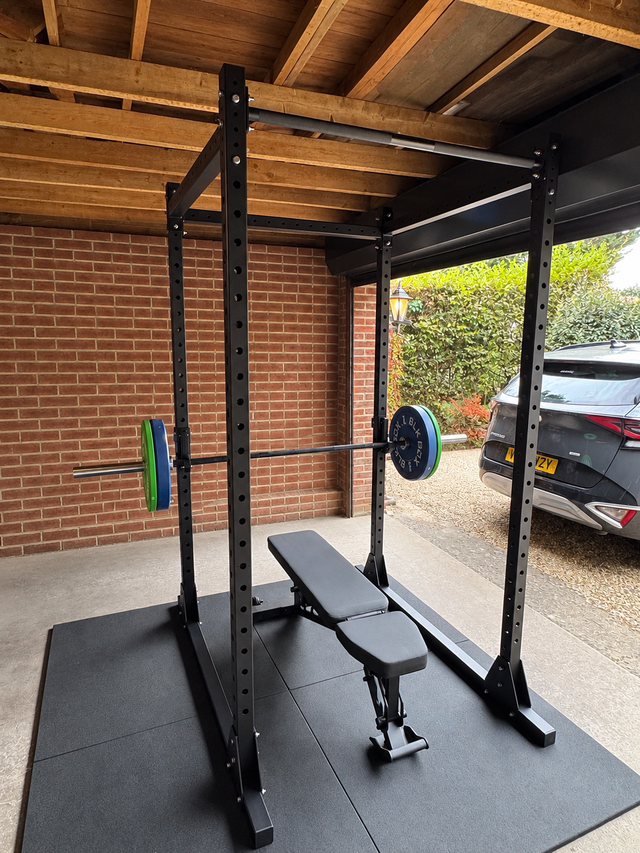
30mm fits. It's published for heavy strength training and higher-impact lifting, and its 200kg drop guide is above a 180kg bar; the 20mm figure of 140kg is below it. Choose 40mm if you drop the bar on most reps or lift close to 200kg. A clean, dry, level concrete floor needs no underlay. The floor rises by 30mm, so check the garage door still closes, or stop the tiles just inside the door and finish that edge with 30mm edge ramps. Fifteen tiles at about 26kg each is about 390kg to carry in from the kerb, and 15 tiles get the 5% bulk discount.
Cardio corner: exercise bike and rower
10mm fits the published use for cardio equipment. Six tiles weigh about 57kg, under 100kg, so they come by parcel courier. Because the corner isn't wall to wall, two sides are open edges. 10mm tiles don't take connectors and there's no 10mm ramp, so fix those edges with rubber floor adhesive. If you'd rather finish the open sides with ramps, 15mm is the thinnest tile with a matching ramp.
PT studio: dumbbells, barbells and all-day use
20mm fits the general floor: it's published for free-weight areas, heavier dumbbells and general commercial use. Weights are dropped more often in a busy studio, and how often they're dropped is one of the three things the right thickness depends on. So use 30mm (heavy strength training) or 40mm (repeated heavy use) where barbells are dropped, and plan the step where the thicknesses meet. The bulk discount counts every tile across thicknesses: 48 tiles get 10%, and it rises to 15% from 50 tiles. The tiles are classified Bfl-s1 for fire (SGS tested), and we can send a data sheet for each thickness.
Does thicker gym flooring make a room quieter?
We can't give you a figure. We don't hold tested acoustic or impact-sound figures for any of our tiles, so we don't claim how much quieter one thickness is than another. If noise is your main worry because the gym is upstairs or in a flat, read what you can lay rubber gym flooring on first.
Is 1 inch gym flooring the same as 25mm?
Almost: 1 inch is 25.4mm. Our tiles don't come in 25mm. Our nearest thicknesses either side are 20mm (about 0.8 in) and 30mm (about 1.2 in). If you're following advice written in inches, convert it, then choose between 20mm and 30mm on what you lift and drop, using the table above, rather than on the nearest number.
If a guide recommends ¾-inch (19mm) mats, our 20mm tiles are the closest.
What else changes as gym flooring gets thicker?
The weight, the floor height, the fitting accessories and the price. A 40mm tile weighs about 34kg against about 9.5kg for 10mm, the floor rises by the tile's thickness, only 20mm and thicker take connectors, and the price per tile rises with thickness. These shouldn't override your training needs, but they can decide between two thicknesses that both fit.
- Carrying and delivery. Orders over 100kg come on a pallet, delivered to the kerbside only, and you carry each tile in from there. On their own, up to 10 tiles of 10mm, 7 of 15mm, 5 of 20mm, 3 of 30mm or 2 of 40mm stay under 100kg and come by parcel courier. Anything else in the order adds to the weight.
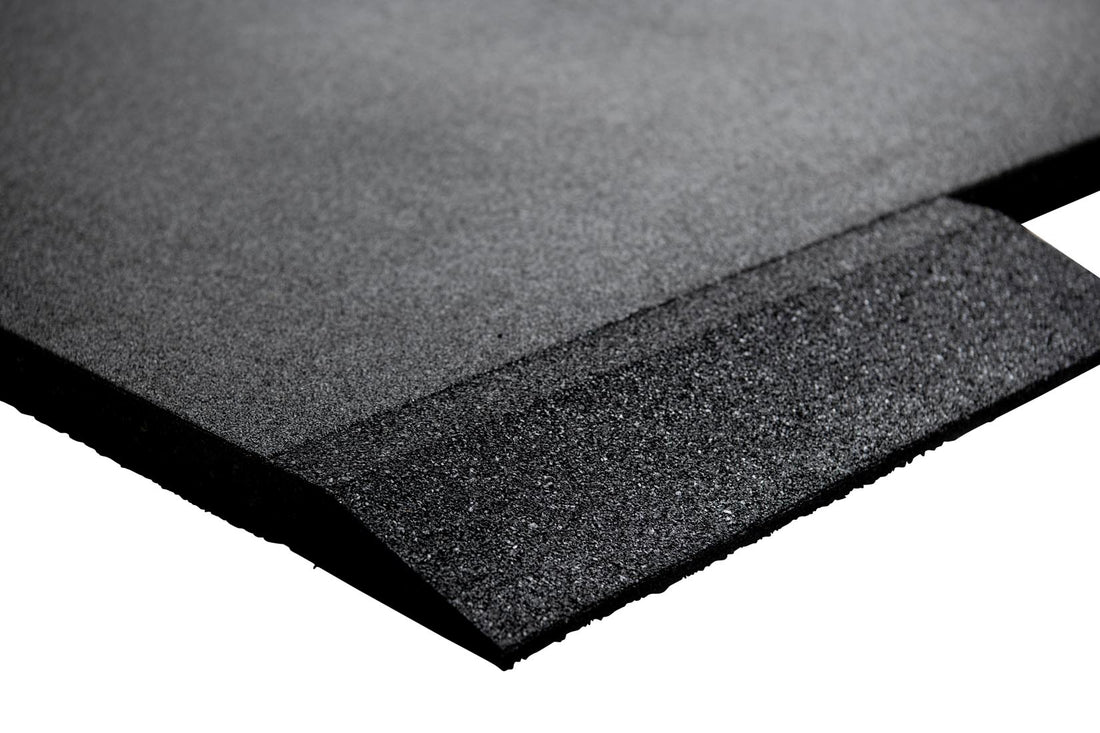
- Floor height. Check that doors opening over the floor will clear it, including a garage door, and finish exposed edges and doorways with edge ramps that match the tile thickness.
- Connectors. Interlocking connectors fit 20mm, 30mm and 40mm tiles only, around 3–4 per tile depending on the layout. 10mm and 15mm tiles have a lay-flat base and don't use them. Our connectors guide shows how they fit.
- Cutting. Use a sharp retractable knife and a straight edge, and change the blade often. Thicker tiles take several passes.
- Price. One tile covers 1 m², so the tile price is the price per square metre. The product cards above show today's price for each thickness.
Can I use different thicknesses in one room?
Yes. You can order more than one thickness, and the bulk discount counts every tile in the order across thicknesses and colours. Where two thicknesses meet, the floor steps by the difference, for example 10mm where 20mm tiles meet 30mm tiles, so decide where that join will run before you order.
The simplest floor is one thickness throughout. If you're planning a mixed floor, contact us about the join before you order.
What thickness for a garage gym?
Choose it for your training, not the room: the table above applies in a garage as anywhere else. Garages with a dry, level floor are within the tiles' intended use, and no underlay is needed over concrete. A thicker floor raises the level at the door, so check the clearance before you choose.
Our garage gym flooring guide covers the rest of a garage floor.
How can I check before I order?
Order a sample to see the thickness and finish in the hand. Samples are 10cm × 10cm, in the thickness and finish you choose; the sample is free and you pay £7.99 postage. Or contact us with your room size, what you train with and what the floor is underneath, and we'll suggest a thickness.
Once you've chosen, how many gym floor tiles you need and the gym flooring calculator give you a quantity, and how to lay rubber gym flooring covers fitting. For everything else about choosing a floor, see rubber gym flooring: a UK buying guide.
About this guide
This guide uses the published specifications of our 1 m rubber gym tiles: the use and drop guide for each thickness, tile weights and size tolerances from the product page, and our delivery and bulk discount terms. The questions come from about 25 customers who asked us which thickness to buy between February and October 2026. The worked examples are calculations from those figures, not tests. We sell the flooring described here.
Written by the Equipped Gym Team. Last reviewed 9 October 2026.