Rubber Gym Tiles vs Foam Jigsaw Mats, Rolls And Stable Mats
Quick answer
Choose gym flooring by what you'll do on it. Foam jigsaw mats are fine for yoga, stretching, bodyweight exercise and children's play; for free weights, machines and dropped weights, choose rubber made as gym flooring, such as our 1 m tiles in 10mm to 40mm with drop guide figures from 80kg to 260kg, or a roll or stable mat whose maker's figures cover your training.

Choose gym flooring by what you'll do on it. Foam jigsaw mats are fine for yoga, stretching, bodyweight exercise and children's play, where nothing heavy is dropped. For free weights, machines and dropped weights, choose rubber made as gym flooring: our 1 m × 1 m rubber tiles come in 10mm to 40mm, with drop guide figures from 80kg to 260kg. A rubber roll or a horse stable mat can work too, if its maker's figures cover your training.
We sell 1 m rubber gym tiles, not foam mats, yoga mats or rubber rolls, so for those we say what to ask the maker.
Which type of gym flooring should I choose?
Start from the heaviest thing that will go on the floor. If it's only you, on a mat for yoga, stretching or bodyweight work, foam is enough. If it's free weights, cardio machines or a barbell, choose rubber made as gym flooring, with a published drop figure that covers your heaviest weight. Outdoors, choose a product made for outdoor use.
| What the floor is for | What to look for | Our 1 m rubber tiles |
|---|---|---|
| Yoga, stretching, bodyweight exercise | Foam jigsaw mats are fine | More than you need: firm (about 65 Shore A) and 9.5kg to 34kg a tile |
| Children's play | A mat made and sold for play | Made and warranted as gym flooring; we can't advise on play use |
| Cardio machines, benches, light free weights | Rubber gym flooring, or a mat whose maker says it takes the machine | 10mm |
| Dumbbell training | Rubber gym flooring | 15mm for moderate dumbbell training, 20mm for heavier dumbbells |
| Barbells, deadlifts, dropped weights | Rubber gym flooring with a drop figure above your loaded bar | 30mm (200kg drop guide) or 40mm (260kg) |
| A garden, patio or drive | A product made for outdoor use | Not recommended: made for indoor use |
The four types side by side:
| 1 m rubber tiles (ours) | Foam jigsaw mats | Rubber rolls | Horse stable mats | |
|---|---|---|---|---|
| What it is | Recycled SBR rubber squares, laid in a brick pattern | Light foam squares with jigsaw edges that lock together | A rubber sheet supplied on a roll, laid in long lengths | Rubber mats made for horse stables |
| Dropped weights | Guide figures from 80kg (10mm) to 260kg (40mm) | Check the maker's figures | Check the maker's figures | Check the maker's figures |
| Fire classification | Bfl-s1 (SGS tested) | Ask the maker | Ask the maker | Ask the maker |
| Handling | About 9.5kg to 34kg per tile, carried one at a time | Light | Each length is one piece; ask its weight | Ask the size and weight of each mat |
| Damage in one spot | Lift out and replace that tile | Replace that mat | One sheet, so a repair means cutting into it | Replace that mat |
The drop figures for our tiles are guide figures: the subfloor, the drop height and how often weights are dropped all matter. How thick gym flooring should be explains each thickness.
Products in this guide
-

Rubber Gym Flooring Mats (1m x 1m)
£17.99
£14.99 ex. VATSale priceFrom £17.99
Regular price
£14.99 ex. VAT£32.00
£26.67 ex. VATUnit price -

White Fleck Rubber Gym Flooring Mats (1m x 1m)
£18.99
£15.83 ex. VATSale priceFrom £18.99
Regular price
£15.83 ex. VAT£32.00
£26.67 ex. VATUnit price -

Sample - Rubber Gym Flooring
£0.00
£0.00 ex. VATSale price£0.00
Regular price
£0.00 ex. VAT
£0.00 ex. VATUnit price -

Gym Flooring Tile Interlocking Connectors
£0.99
£0.83 ex. VATSale priceFrom £0.99
Regular price
£0.83 ex. VAT
£0.00 ex. VATUnit price


When are foam jigsaw mats fine?
When nothing heavy is dropped on them or stands on them: yoga, stretching, bodyweight exercise and children's play. Foam is light and soft underfoot, and the mats come apart and stack away. For dropped weights, heavy dumbbells, barbells or machines, choose a floor whose maker publishes figures for that use. Foam is the wrong choice there unless its maker says otherwise.
- Fine on foam: yoga, stretching and mobility work, bodyweight circuits, and a soft play corner for children.
- Ask the maker first: an exercise bike, rower or bench. Ask whether the mats are made to carry that machine.
- Choose rubber instead: anything you'll drop, dumbbell or kettlebell work where weights go down hard, barbells and deadlifts. Our deadlift flooring guide covers the heaviest end.
- Both in one room: rubber where the weights are and foam in a stretching corner works, as long as you plan for any step where the two meet.
Rubber rolls or 1 m rubber tiles: which should I choose?
Both are rubber, so the difference is the format. A roll is one long sheet with fewer joints, but each length is a single heavy piece to move and cut to the room, and a repair means cutting into it. Tiles are carried, laid and replaced one square metre at a time. Ask a roll's maker for drop figures; ours are published for each thickness.
| Rubber roll | Our 1 m tiles | |
|---|---|---|
| Joints | Fewer, one between each length | A joint every metre, staggered in a brick pattern |
| Carrying it in | One piece per length; ask its weight | One tile at a time, about 9.5kg (10mm) to 34kg (40mm) |
| Fitting the room | Each length cut to the room | Whole tiles laid from the centre, edge tiles cut to fit with a knife |
| Different thicknesses in different areas | Ask the maker | Any mix of 10mm to 40mm; the floor steps where two thicknesses meet |
| Drop figures | Check the maker's figures | Guide figures from 80kg to 260kg |
- Why tiles show joints. Moulded rubber shrinks slightly as it cools, so each tile is made to a size tolerance: 0.4–1% (about 990–1010mm) for 15mm to 40mm, and ±1.5% for 10mm. Dry lay the whole floor first and rotate or swap tiles to tighten the joints. The brick pattern helps hide small differences.
- Taking it with you. Tiles laid loose, without adhesive, can be lifted a tile at a time.
- Which suits you. If you want as few joins as possible across a big open floor, a roll is the format made for that. If you're laying it yourself, want a thicker area for lifting, or might lift the floor later, tiles make that simpler.
Are interlocking rubber mats the same as jigsaw mats?
Not always. "Interlocking" is used for rubber tiles with jigsaw-shaped edges, and also for square tiles joined underneath. Our 20mm, 30mm and 40mm tiles are square, with a 45° bevelled top edge, and join with plastic connectors that push into the base. Our 10mm and 15mm tiles have a flat base and don't take connectors. Laid wall to wall on a clean, dry, level floor, all of them stay in place under their own weight.

- How many connectors. Around 3–4 per tile, depending on the layout. They hold the tiles in line so the joints stay tight. Our connectors guide shows how they fit.
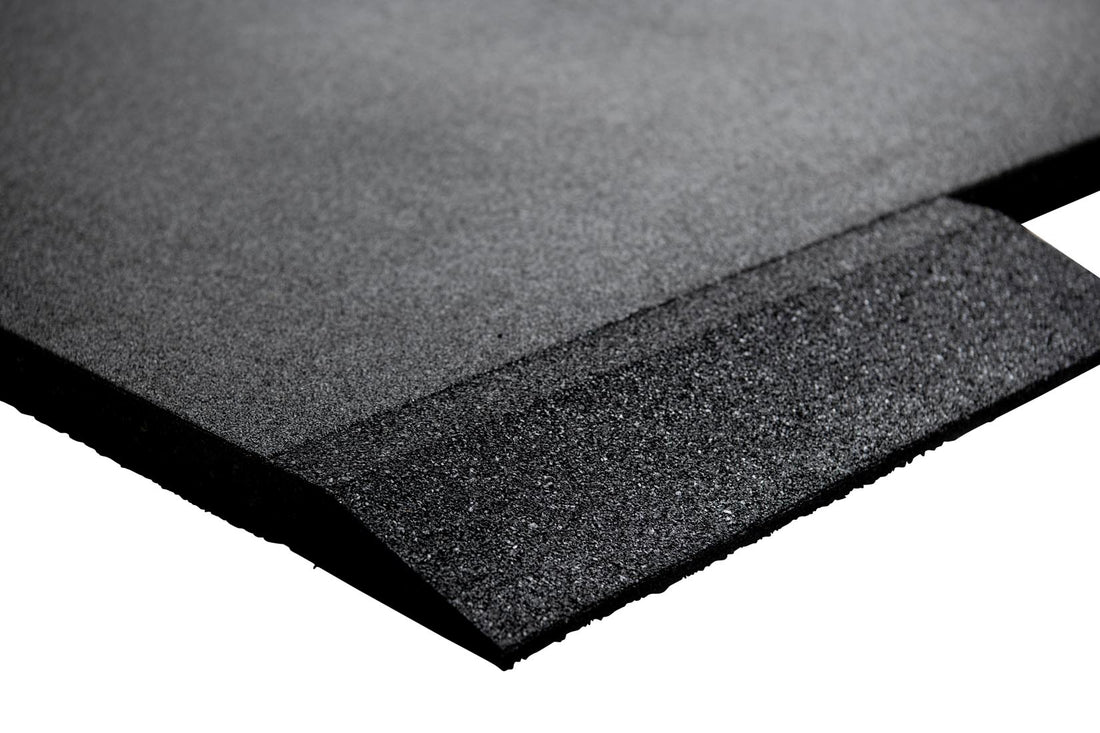
- Open edges. Where the floor stops short of a wall, finish the edge with edge ramps matched to the tile thickness, or a suitable adhesive. There's no 10mm ramp.
- "Mats" or "tiles". Our product pages call them rubber gym flooring mats. In our guides, "tiles" means the same 1 m squares.
Are horse stable mats OK for a home gym?
They can be, but they're made for stables, not gyms. Before you buy, ask the maker for a drop figure that covers your heaviest weight, the size and weight of each mat, how the mats join, what the top surface is like to train on and clean, and a fire classification if a landlord, insurer or specification asks for one.
Customers ask us how our tiles compare with a solid rubber stable mat. These are the figures to ask a stable mat seller for, so you can compare like with like:
| What to compare | Our 1 m tiles |
|---|---|
| Made and warranted for | Indoor home and commercial gyms |
| Dropped weights | Guide figures by thickness, from 80kg (10mm) to 260kg (40mm) |
| Fire classification | Bfl-s1 (SGS tested) |
| Size and weight | Nominal 1 m × 1 m, about 9.5kg (10mm) to 34kg (40mm) |
| Warranty | Five-year limited warranty against premature structural cracking caused by a manufacturing defect, in normal indoor gym use |
What are the downsides of rubber gym tiles?
Weight, height and joints. Each tile weighs about 9.5kg (10mm) to 34kg (40mm), and orders over 100kg come on a pallet unloaded at the kerbside, so you carry every tile in. The floor rises by the tile's thickness, there's a joint every metre, and new tiles can have a mild rubber smell that fades once they're unpacked and the room is ventilated.

- Doors. Check that doors opening over the floor still clear it, including a garage door.
- Squares only. We can't supply custom sizes or cut tiles for you. Edge tiles are cut on site with a sharp retractable knife and a straight edge, and thicker tiles take several passes.
- Indoors only. The tiles are water resistant, not waterproof. Sun and standing water shorten their life, and outdoor use isn't covered by the warranty. Garages, sheds and garden rooms with a dry, level floor are fine.
- Firm, not soft. At about 65 Shore A, they aren't a cushioned surface to lie or kneel on.
- Other uses. Customers use them in play areas, workshops and utility rooms, but they're made and warranted as gym flooring, and we can't advise on other uses.
Which type of gym flooring is quietest?
We can't tell you. We don't hold tested acoustic or impact-sound figures for our tiles, and we can't give figures for foam, rolls or stable mats. If noise matters most, ask each maker for tested figures at the thickness you're considering, so you compare like with like rather than descriptions.
If the gym is upstairs, read what you can lay rubber gym flooring on before you choose.
How do I compare the cost per square metre?
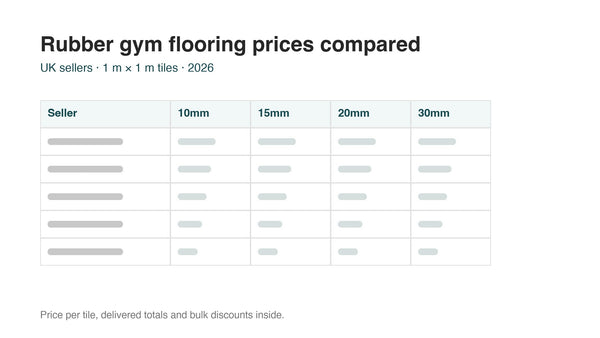
We can't tell you which type costs least, because we only sell one of them. Compare the delivered cost of the whole floor, not the price of one piece. One of our tiles covers 1 m², so the tile price is the price per square metre (the product cards above show today's prices). Add delivery, edging and spares for cuts, take off any bulk discount, and ask other sellers for the same total.
For our tiles:
- Delivery. Free on UK mainland orders over £300. Smaller orders pay a charge based on their weight, and orders over 100kg come on a pallet (£59.99), unloaded at the kerbside.
- Bulk discount. Applied automatically: 5% from 10 tiles, 10% from 25, 15% from 50, 20% from 100 and 25% from 200, counted across thicknesses and colours.
- Edging and fixings. Edge ramps for open edges (there's no 10mm ramp), connectors for 20mm to 40mm tiles, and adhesive where an edge needs securing.
- Cuts. Count one tile per square metre, rounded up, plus an allowance for cuts. How many gym floor tiles you need works it through.
For example, a 3 m × 4 m spare room in 15mm takes 12 tiles, which get the 5% bulk discount. They weigh about 162kg, so they come on a pallet, and if the order is under £300 the £59.99 pallet charge applies. 15mm tiles take edge ramps but not connectors. Get a delivered price for 12 m² of any other type, with its edging, and compare the two totals.
How can I see the rubber before I buy?
Order a sample: a 10cm × 10cm square in the thickness and finish you choose, black or white fleck. The sample is free and you pay £7.99 postage. Or contact us with your room size, what you train with and what the floor is underneath, and we'll suggest a thickness.
For the rest of the decision, see how thick gym flooring should be, garage gym flooring in the UK and rubber gym flooring: a UK buying guide, or browse all our rubber gym flooring tiles.
About this guide
This guide compares types of flooring, not brands. It uses the published specifications of our 1 m × 1 m rubber gym tiles (thicknesses, uses, drop guide figures, weights, size tolerance, hardness, fire classification and warranty, from the product page on 9 October 2026), our delivery and bulk discount terms, and questions customers send us about foam, stable mats and rubber tiles. We don't sell foam mats or rubber rolls, and we give no figures for other sellers' stable mats. The room example is our arithmetic, not a measurement. We sell the rubber tiles described here.
Written by the Equipped Gym Team. Last reviewed 9 October 2026.