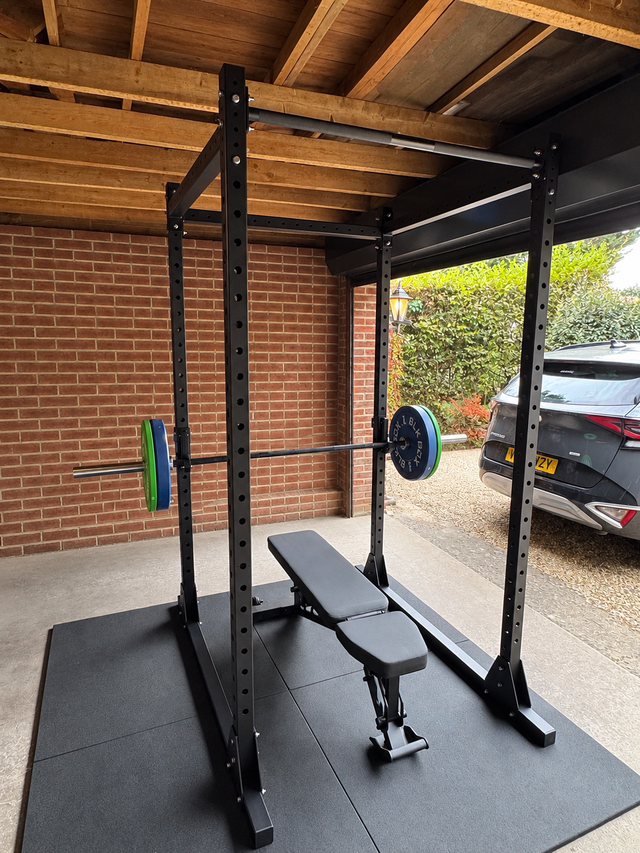
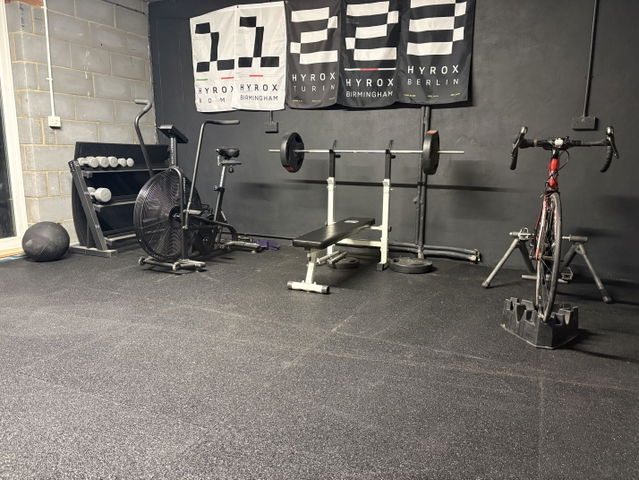
Gym Flooring For Deadlifts And Dropped Weights
Quick answer
For deadlifts at home, lift on 30mm rubber tiles, published for heavy strength training with a 200kg drop guide figure, or 40mm, published for Olympic lifting and repeated heavy use with 260kg. A 3 m × 2 m area of six 1 m tiles takes a 7ft Olympic bar, and only bumper plates are made to be dropped.

For deadlifts and dropped barbells at home, lift on 30mm or 40mm rubber tiles. 30mm is published for heavy strength training, power racks and higher-impact lifting, with a 200kg drop guide figure; 40mm for Olympic lifting and repeated heavy use, with 260kg. Count the whole loaded bar, choose 40mm if you drop it on most reps or lift close to 200kg, and drop only bumper plates.
We sell the tiles, accessories and plates in this guide. We don't sell lifting platforms or deadlift pads.
Should I use 30mm or 40mm flooring for deadlifts?
Use 30mm if your heaviest loaded bar is under 200kg and you usually set it down. Use 40mm if you drop the bar on most reps, lift close to or over 200kg, or do Olympic lifts. Both are guide figures: the subfloor, the height you drop from and how often you drop all matter, so go up a thickness when you're near the line.
| 30mm | 40mm | |
|---|---|---|
| Published use | Heavy strength training, power racks and higher-impact lifting | Olympic lifting and repeated heavy use |
| Drop guide | Up to 200kg | Up to 260kg |
| Weight per tile | About 26kg | About 34kg |
| Floor rises by | 30mm | 40mm |
| Takes connectors, matching edge ramps and corner pieces | Yes | Yes |
Count the whole loaded bar, not just the plates. For example:
- 170kg: our 7ft bar (20kg) with the 150kg bumper plate set. That's within the 30mm figure. Choose 40mm if you'll drop it on most reps.
- 220kg: the same bar with four 25kg bumper plates a side, about the most its sleeves hold in bumpers. That's over the 30mm figure and within the 40mm one.
- Over 260kg: the load is above every drop figure we publish, so contact us before you order.
- Under 140kg, rarely dropped: 20mm, published for free-weight areas, may cover it. The thickness guide explains when.
- Dropped dumbbells and kettlebells: count the heaviest single one, then see which thickness suits dumbbells.
If you deadlift in or beside a power rack, 30mm's published use includes power racks, so one 30mm floor can take both. We don't sell racks.
Drop figures are guide figures, not a guarantee of protection. The right thickness also depends on your subfloor, the drop height and how often weights are dropped.
Products in this guide
-

30mm Rubber Gym Flooring Mats (1m x 1m)
£33.99
£28.33 ex. VATSale price£33.99
Regular price
£28.33 ex. VAT£48.00
£40.00 ex. VATUnit price -

40mm Rubber Gym Flooring Mats (1m x 1m)
£44.99
£37.49 ex. VATSale price£44.99
Regular price
£37.49 ex. VAT£65.00
£54.17 ex. VATUnit price -
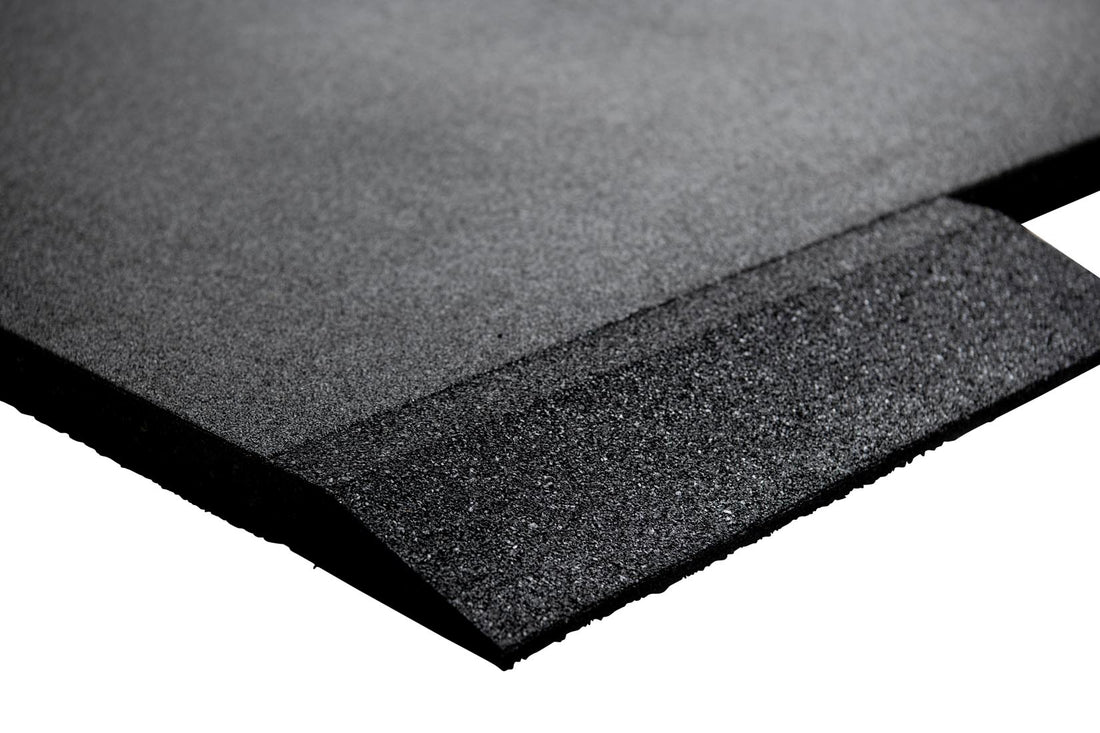
Rubber Gym Flooring Edge Ramps
£9.99
£8.33 ex. VATSale priceFrom £9.99
Regular price
£8.33 ex. VAT
£0.00 ex. VATUnit price -

Rubber Gym Flooring Corner Piece
£9.99
£8.33 ex. VATSale price£9.99
Regular price
£8.33 ex. VAT
£0.00 ex. VATUnit price -

Gym Flooring Tile Interlocking Connectors
£0.99
£0.83 ex. VATSale priceFrom £0.99
Regular price
£0.83 ex. VAT
£0.00 ex. VATUnit price -

Olympic Black Bumper Plates 5kg-25kg
£54.99
£45.83 ex. VATSale priceFrom £33.99
Regular price
£28.33 ex. VAT
£0.00 ex. VATUnit price


How big should a deadlift area be?
At least as wide as your bar, so every plate lands on rubber. A 7ft Olympic bar is 220cm long, so make the area three tiles (3 m) wide: one row (3 m × 1 m) is three tiles, and two rows (3 m × 2 m) are six and give the bar more room front to back. A 142cm trap bar fits on 2 m × 2 m, four tiles.
| Bar (length) | Area | Tiles | Weight at 30mm | Weight at 40mm |
|---|---|---|---|---|
| 7ft Olympic bar (220cm) | 3 m × 1 m, one row | 3 | About 78kg | About 102kg |
| 7ft Olympic bar (220cm) | 3 m × 2 m, two rows | 6 | About 156kg | About 204kg |
| Hex trap bar (142cm) or 6ft Olympic bar (183cm) | 2 m × 2 m, two rows | 4 | About 104kg | About 136kg |
A 6ft bar on a 2 m-wide area leaves about 8cm of tile beyond each end. Make the area three tiles wide if you want more margin.
- Two rows go in a brick pattern, like every floor of our tiles. The second row starts and ends with a half tile, so a 3 m × 2 m area is five whole tiles and one cut in half, and a 2 m × 2 m area is three whole tiles and one cut in half. Thick tiles take several passes with a sharp knife; the laying guide covers cutting.
- Delivery. Orders over 100kg come on a pallet, so every area in the table does except three 30mm tiles (about 78kg). A pallet is unloaded at the kerbside, and you carry each 26kg or 34kg tile in from there.
- Delivery charge. UK mainland orders over £300 are delivered free. Below that, the charge is based on weight (£59.99 for a pallet), and the cost for your basket is shown under the Add to basket button.
How do I finish the edges of a lifting area?
If the area doesn't run wall to wall, finish each open side with edge ramps, or secure it with adhesive. Ramps are 500mm long and 150mm deep, made in 30mm and 40mm (and 15mm and 20mm), so count one per 0.5 m of open edge. Where two ramps meet at an outside corner, a corner piece (20, 30 or 40mm) finishes it.
| Where a 3 m × 2 m area sits | Open edge | Edge ramps | Corner pieces | Floor space with ramps |
|---|---|---|---|---|
| In the middle of a room | 10 m | 20 | 4 | About 3.3 m × 2.3 m |
| Against one wall, along its 3 m side | 7 m | 14 | 2 | About 3.3 m × 2.15 m |
| In a corner | 5 m | 10 | 1 | About 3.15 m × 2.15 m |

- Fixing ramps and corners. 30mm and 40mm ramps and corner pieces fit the connectors, but their product pages recommend rubber floor adhesive to hold them in place and avoid gaps.
- Connectors between tiles. 30mm and 40mm tiles take interlocking connectors in the base, around 3–4 per tile depending on the layout. They hold the tiles in line so the joints stay tight. The connectors guide shows how they fit.
- Sides against a wall need no ramp.
Shop the edge ramps and corner pieces in the thickness of your tiles.
Do I need a lifting platform?
You don't have to have one. 30mm and 40mm tiles are published for heavy strength training and Olympic lifting, and our bumper plate pages say to use the plates on suitable gym flooring or a lifting platform. We don't sell platforms or deadlift pads, and we hold no figures comparing a platform with our tiles, so we can't tell you one does more for your floor than the other.
- A lifting platform is a raised base, bought or built as one unit, that sits on top of your floor. If you're considering one, ask its maker what it's rated for, what it weighs and how much it raises the floor.
- Stacking tiles. Some lifters lay a second layer of flooring where they lift. Our drop guide gives one figure for a single tile of each thickness. It doesn't cover two tiles stacked, so we can't tell you what a stacked floor will take. The thickest single tile we sell is 40mm, published for repeated heavy use.
- Deadlift pads are separate pads that sit where the plates land. We don't sell them.
Which weight plates can I drop on rubber tiles?
Only bumper plates. Our black and colour bumper plates have a cast iron core inside a high-density rubber coating, and every weight is 450mm across. Our rubber tri-grip and cast iron plates aren't designed to be dropped, and damage from dropping them isn't covered by the warranty. That's about the plates, not the floor, so it applies on 40mm tiles too.
| Plates | What they're made of | Diameter | Made to be dropped? |
|---|---|---|---|
| Black bumper plates and colour bumper plates | Cast iron core, high-density rubber coating | 450mm at every weight | Yes |
| Rubber tri-grip plates | Cast iron, rubber coated, three handles | 16cm (1.25kg) to 43cm (25kg) | No |
| Cast iron plates | Deep-dish cast iron | 16cm (1.25kg) to 44.3cm (25kg) | No |
Bumper plates are thick for their weight: a 25kg plate is 88mm. Four of them take 352mm of each 415mm sleeve on our 7ft bar, which with a collar is about the limit. That's why a 7ft bar loaded with 25kg bumpers tops out at about 220kg.

See all our bumper plates.
Can I deadlift on rubber tiles upstairs?
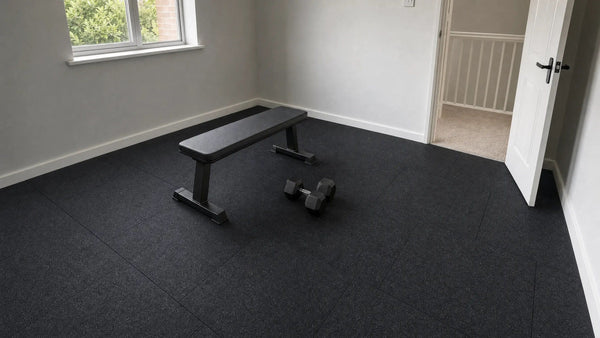
The tiles are fine on a firm, flat upstairs floor. What we can't tell you is whether the floor will take heavy deadlifts, or how much the room below will hear. Ask a structural engineer or builder before you lift heavy upstairs. The drop figures depend on the subfloor too, and a timber floor is a very different base from a concrete slab.
Give them the loads, not just the thickness:
- The flooring: a 3 m × 2 m area weighs about 156kg in 30mm or 204kg in 40mm, before anything goes on it.
- The bar and plates: for example 170kg for our 7ft bar with the 150kg bumper set.
- Everything else: your own weight, and any rack, bench or dumbbells in the room.
What you can lay rubber gym flooring on covers upstairs rooms and timber floors in more detail.
Will thicker flooring stop the noise and bounce?
We can't promise it will. We don't hold tested acoustic or impact-sound figures for any of our tiles, so we don't claim how much quieter 40mm is than 30mm, or how much a dropped bar bounces on either. Choose the thickness for your loaded bar and how often you drop it, as above.
If noise in the room below or next door is your main concern, raise it with the engineer or builder who checks the floor.
Should the whole floor be 30mm or 40mm, or just the lifting area?
Either works. One thickness throughout is the simplest floor, with no step anywhere. A 30mm or 40mm lifting area inside a thinner floor means fewer heavy tiles to carry, but the floor steps where the two thicknesses meet, so decide where that join runs before you order.
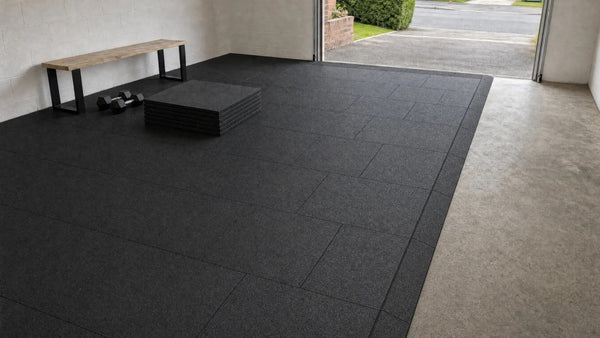
For example, a 3 m × 5 m garage with a 3 m × 2 m lifting area at the back in 40mm and the rest in 20mm for dumbbells and a bench:
| Floor | Tiles | Weight | Bulk discount |
|---|---|---|---|
| 40mm lifting area, 20mm elsewhere | 6 at 40mm, 9 at 20mm | About 362kg | 5% (15 tiles) |
| 40mm throughout | 15 at 40mm | About 510kg | 5% (15 tiles) |
- The bulk discount counts every tile in the order across thicknesses and colours: 5% from 10 tiles, 10% from 25, 15% from 50, 20% from 100 and 25% from 200, applied automatically.
- The step in the mixed floor is 20mm, where 40mm tiles meet 20mm tiles across the garage. Contact us about finishing that join before you order, and see using different thicknesses in one room.
- Both floors are pallet deliveries, unloaded at the kerbside.
How can I check before I order?
Order a sample to see the thickness in your hand: a 10cm × 10cm square in the thickness and finish you choose, free apart from £7.99 postage. Or contact us with your heaviest loaded bar, how often you drop it, what's under the floor and the size of the area, and we'll suggest a thickness.
- Quantities for the rest of the room: how many gym floor tiles you need.
- Garages: garage gym flooring in the UK covers doors, slabs and carrying the tiles in.
- Other types of flooring: rubber gym tiles vs foam jigsaw mats, rolls and stable mats.
- Everything else about buying a floor: rubber gym flooring: a UK buying guide, or browse the 30mm and 40mm rubber gym tiles.
About this guide
This guide uses the published specifications of our 1 m × 1 m rubber gym tiles (the use and drop guide figure for each thickness, and tile weights, from the product page), the edge ramp, corner piece and connector product pages, and the bar and plate specifications on their product pages and in our help centre, all checked on 9 October 2026. Delivery and bulk discount terms are our current ones. The questions come from customers planning deadlift areas. The lifting areas, weights and examples are our arithmetic from those figures, not tests. We sell the tiles, accessories and plates described here; we don't sell lifting platforms.
Written by the Equipped Gym Team. Last reviewed 9 October 2026.