Garage Gym Flooring: A UK Guide
Quick answer
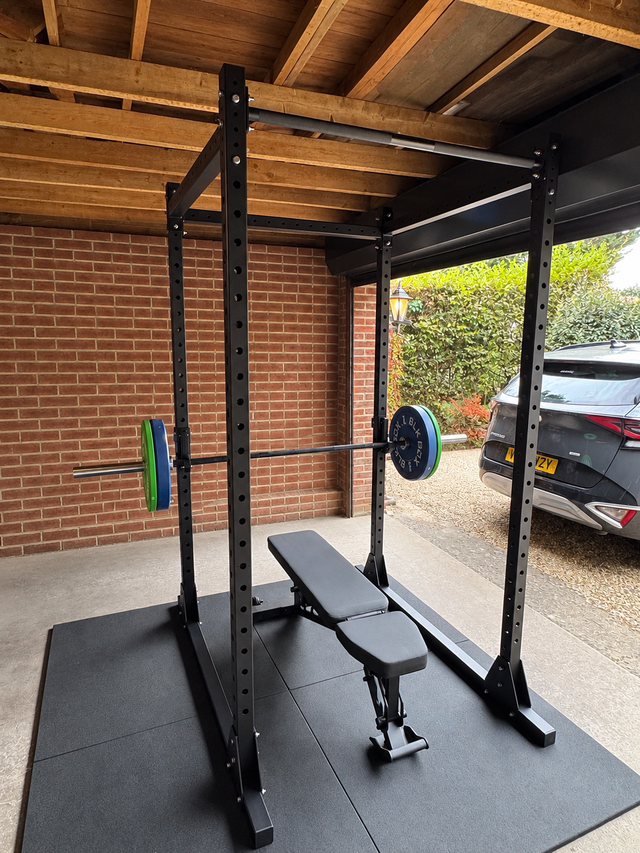
Lay 1 m rubber tiles straight onto a clean, dry, level concrete garage floor. You need no underlay, and laid wall to wall the tiles stay put under their own weight. Choose the thickness for your training, from 15mm for a general home gym to 40mm for Olympic lifting, and allow one tile per square metre: 13 for a 2.5 × 5 m single garage.

Our 1 m × 1 m rubber tiles go straight onto a clean, dry, level concrete garage floor. You don't need underlay, and laid wall to wall the tiles stay in place under their own weight. Choose the thickness for your training rather than the room, from 15mm for a general home gym to 40mm for Olympic lifting, and count one tile per square metre: a 2.5 × 5 m single garage takes 13 tiles before cuts. Check that the door still closes over the floor, and finish any open edge with ramps.
We sell these tiles and the accessories in this guide. We don't sell foam mats or rubber rolls.
Rubber tiles, foam mats or rubber rolls: which suits a garage?
For lifting, choose a floor that takes the weights you'll drop, stays put on concrete, cuts to fit your walls and door, and can be repaired a piece at a time. Our 1 m rubber tiles are made as gym flooring, with drop guide figures from 80kg (10mm) to 260kg (40mm). We can't give figures for foam or rolls.
| 1 m rubber tiles (ours) | Foam jigsaw mats | Rubber rolls | |
|---|---|---|---|
| What it is | Recycled SBR rubber squares, 10mm to 40mm thick, laid in a brick pattern | Light foam squares with jigsaw edges that lock together | A rubber sheet supplied on a roll and laid in long lengths |
| Dropped weights | Guide figures from 80kg (10mm) to 260kg (40mm) | Check the maker's figures | Check the maker's figures |
| Staying in place | Laid wall to wall, the tiles' own weight holds them; open edges are secured with ramps or adhesive, and connectors hold 20mm to 40mm tiles in line | Held together by the jigsaw edges | Check the maker's guidance |
| Fitting to walls and the door | Cut edge tiles with a sharp knife and a straight edge; thicker tiles take several passes | Cut to fit | Each length cut to the room |
| Damage in one spot | Lift out and replace that tile | Replace that mat | One continuous sheet, so a repair means cutting into it |
| Handling | About 9.5kg (10mm) to 34kg (40mm) per tile | Light | Supplied as one long piece |
Rubber tiles aren't the right choice for every garage:
- Outdoors. The tiles are made for indoor use. A garage with a roof, walls and a dry, level floor is fine, but on a drive or patio they aren't recommended: they're water resistant, not waterproof, sun and standing water shorten their life, and outdoor use isn't covered by the warranty.
- A floor you need to clear often. At up to 34kg a tile, lifting and stacking a whole floor regularly is heavy work. If you need the space back often, floor only the area you train on.
- A slab that isn't dry or level. Sort that out first (next section).
How do I prepare a concrete garage floor?
Make the slab clean, dry and level, then lay the tiles straight onto it. No underlay is needed over concrete. Sweep and vacuum away grit and dust, fill holes and cracks so every tile sits flat, and make sure the floor stays dry, including where rain can get in under the door.
- Clean. Sweep, then vacuum, so nothing is trapped under the tiles.
- Dry. The tiles are water resistant, not waterproof, and standing water shortens their life. If the slab is damp, or water gets in under the door, deal with the cause before you lay (and see questions to ask us before you order).
- Level. Fill holes and cracks so each tile sits flat and the joints close up.
- No underlay, and usually no glue. Laid wall to wall on a clean, dry, level floor, the tiles stay in place. Secure an open edge with edge ramps or a suitable adhesive.
- Dry lay before you cut. Put the whole tiles down in a brick pattern, working out from the centre, rotate or swap them to tighten the joints, and leave the perimeter cuts until last.
The laying guide takes you through the full job, and what you can lay rubber gym tiles on covers other subfloors.
Which thickness for a garage gym?
Choose by your training, not by the room. 10mm suits cardio equipment, benches and light free weights; 15mm general home gyms and moderate dumbbell training; 20mm free-weight areas and heavier dumbbells; 30mm heavy strength training and power racks; and 40mm Olympic lifting and repeated heavy use. In a garage, also check the door clearance and how heavy each tile is to carry.
| Thickness | What it's for | Drop guide | Weight per tile | Connectors | Edge ramps |
|---|---|---|---|---|---|
| 10mm | Cardio equipment, benches and light free weights | Up to 80kg | About 9.5kg | No | No 10mm ramp; use adhesive on open edges |
| 15mm | General home gyms and moderate dumbbell training | Up to 110kg | About 13.5kg | No | Yes |
| 20mm | Free-weight areas and heavier dumbbells | Up to 140kg | About 17.5kg | Yes | Yes |
| 30mm | Heavy strength training, power racks and higher-impact lifting | Up to 200kg | About 26kg | Yes | Yes |
| 40mm | Olympic lifting and repeated heavy use | Up to 260kg | About 34kg | Yes | Yes |
The drop figures are guide figures. The subfloor, the height you drop weights from and how often you drop them all matter. Three things are specific to a garage:
- Door clearance. The floor rises by the tile thickness, 10mm to 40mm. See doors and open edges below.
- Carrying. A pallet is unloaded at the kerb, so you carry every tile to the garage. A 40mm tile weighs about 34kg.
- Open edges. 10mm tiles have no matching ramp, and only 20mm, 30mm and 40mm tiles take connectors.
For worked examples by training style, see how thick gym flooring should be. If you can't decide between two thicknesses, order a sample: a 10cm × 10cm square in the thickness and finish you choose. The sample is free and you pay £7.99 postage.
Products in this guide
-

Rubber Gym Flooring Mats (1m x 1m)
£17.99
£14.99 ex. VATSale priceFrom £17.99
Regular price
£14.99 ex. VAT£32.00
£26.67 ex. VATUnit price -

20mm Rubber Gym Flooring Mats (1m x 1m)
£23.99
£19.99 ex. VATSale price£23.99
Regular price
£19.99 ex. VAT£34.50
£28.75 ex. VATUnit price -

30mm Rubber Gym Flooring Mats (1m x 1m)
£33.99
£28.33 ex. VATSale price£33.99
Regular price
£28.33 ex. VAT£48.00
£40.00 ex. VATUnit price -
Rubber Gym Flooring Edge Ramps
£9.99
£8.33 ex. VATSale priceFrom £9.99
Regular price
£8.33 ex. VAT
£0.00 ex. VATUnit price


How many tiles for a single or double garage?
Allow one tile per square metre, rounded up, plus an allowance for cuts. Garage sizes vary, so measure yours; the sizes below are examples, not standards. A 2.5 × 5 m single garage takes 13 tiles before cuts and a 5 × 5 m double takes 25. Use the gym flooring calculator for your own measurements.
| Example | Size | Tiles before cuts | Bulk discount | Weight of the tiles, 10mm to 40mm |
|---|---|---|---|---|
| Training area in a garage | 3 × 3 m | 9 | None (starts at 10 tiles) | About 86kg to 306kg |
| Single garage | 2.5 × 5 m | 13 | 5% | About 124kg to 442kg |
| Larger single garage | 3 × 6 m | 18 | 5% | About 171kg to 612kg |
| Double garage | 5 × 5 m | 25 | 10% | About 238kg to 850kg |
| Larger double garage | 6 × 6 m | 36 | 10% | About 342kg to 1,224kg |
Every example comes on a pallet, apart from the 3 × 3 m area in 10mm (about 86kg), because any order over 100kg is a pallet delivery. The pallet is unloaded at the kerbside onto a solid surface, not over gravel or up steps, so plan to carry the tiles in: a 13-tile single garage in 20mm is about 228kg, in 17.5kg tiles.
Measure along each wall at floor level and use the longest figures, and note any step, pier or door frame you'll cut around. How many gym floor tiles you need explains L-shaped floors, how the brick pattern uses half tiles, and what decides your allowance for cuts.
How do I keep the cost down?
Buy the thickness your training needs, floor only the area you use, and let the bulk tiers and the free delivery threshold work for you. Thinner tiles cost less per tile (the product cards show live prices). Bulk discounts start at 5% off 10 tiles, and UK mainland orders over £300 are delivered free.
- Bulk tiers apply automatically: 5% off from 10 tiles, 10% from 25, 15% from 50, 20% from 100 and 25% from 200, counted across thicknesses and colours. There are no codes to enter.
- Watch the pallet charge. On orders under £300 delivery is charged by weight, and anything over 100kg goes on a pallet at £59.99. Six 20mm tiles already weigh about 105kg. The delivery cost for your order is shown under the Add to basket button on our flooring pages.
What about the garage door and open edges?
Check that the door still closes with the tiles down, because the floor rises by the tile thickness. If it won't clear, stop the tiles short of the door line and finish the edge with ramps, so the door closes onto the concrete. Any other open edge, such as a floor that stops partway across the garage, also needs ramps or adhesive.
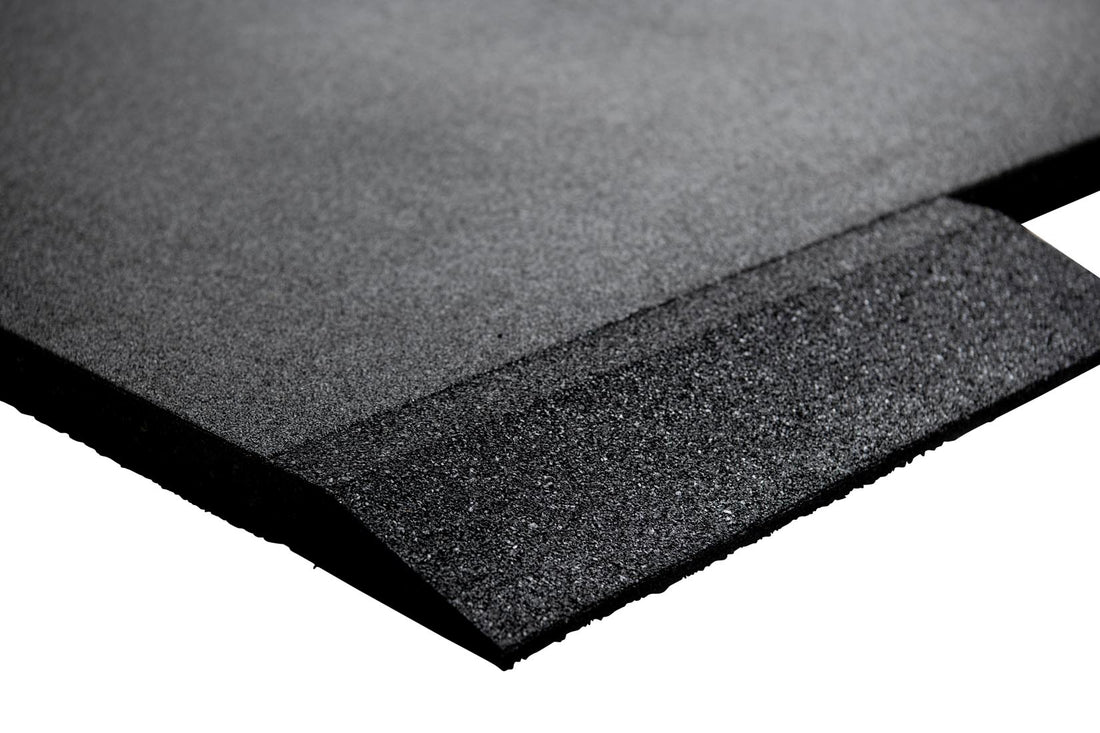
- Ramps. Edge ramps are 500mm long and 150mm deep, made for 15mm, 20mm, 30mm and 40mm tiles. Match the ramp to the tile thickness; there's no 10mm ramp. Allow for the ramp's 150mm depth when you decide where the tiles stop.
- How many ramps. Divide each open edge by 0.5 m. Across the door end of a 2.5 m-wide garage that's 5 ramps; across a 5 m double garage, 10.
- Fixing. The edge ramp product page recommends fixing ramps with rubber floor adhesive; 20mm, 30mm and 40mm ramps also take connectors.
- Floors that don't reach every wall. Connectors hold 20mm, 30mm and 40mm tiles in line, about 3–4 per tile depending on the layout. 10mm and 15mm tiles don't take connectors, so adhesive is the way to add restraint.

Will rubber tiles make a cold garage warmer?
We can't promise that. Rubber is an insulator, but we don't hold tested thermal resistance figures (R-value or tog) for these tiles, so we can't say how much warmer they make a cold slab or the room. They're made as gym flooring, not insulation, so heating or insulating the garage is a separate job.
How do I keep a garage gym floor clean?
Vacuum or sweep with a soft brush, then damp mop with a flat microfibre mop and a pH-neutral cleaner made for rubber flooring. Don't hose the floor down or use a string mop, because excess water can seep between the tiles. Avoid bleach, solvents and strong degreasers.
The floor care products include a cleaner and a microfibre spray mop, and the cleaning guide covers routine and deep cleans.
Garage questions to ask us before you order
Three garage questions need an answer for your own garage, so ask us rather than guess: whether a garage slab needs a damp-proof membrane under the tiles, whether you can park a car on them, and how the tiles behave through winter in an unheated garage. If any of these applies to you, contact us before you order.
About this guide
We wrote this guide from the published specification of our 1 m × 1 m rubber gym tiles and accessories (thicknesses, uses, drop guide figures, weights and ramp sizes, from the product pages), our delivery terms and bulk discount tiers, and the garage questions customers send us. The garage sizes are examples, not standards, and the tile counts and weights are our own arithmetic from the published figures. For the wider buying decision, see our rubber gym flooring buying guide, or browse the rubber gym flooring collection.
Written by the Equipped Gym Team. Last reviewed: 9 October 2026.